

How To Create Foreign Key In Sql Developer
Summary: in this tutorial, you will learn how to use the Oracle foreign key to establish the relationship between tables.
Introduction to Oracle foreign key constraint
A foreign key is all about the relationship. Let's start with an example to clearly understand its concept.
Suppose, we have two tables supplier_groups and suppliers:
Code language: SQL (Structured Query Language) ( sql )
CREATE TABLE supplier_groups( group_id NUMBER GENERATED BY DEFAULT AS IDENTITY, group_name VARCHAR2(255) NOT NULL, PRIMARY KEY (group_id) ); CREATE TABLE suppliers ( supplier_id NUMBER GENERATED BY DEFAULT AS IDENTITY, supplier_name VARCHAR2(255) NOT NULL, group_id NUMBER NOT NULL, PRIMARY KEY(supplier_id) );
The supplier_groups table stores supplier groups e.g., one-time supplier, third-party supplier, and inter-co supplier. Each supplier group may have zero, one, or many suppliers.
The suppliers table stores the supplier information. Each supplier must belong to a supplier group.
The relationship between supplier_groups and suppliers table is one-to-many. In other words, one supplier group has many suppliers while each supplier must belong to a supplier group.
The group_id in the suppliers table is used for establishing the relationship between rows in the suppliers and supplier_groups tables.
Before inserting a row into the suppliers table, you have to look up an existing group_id in the supplier_groups table and use this value for insertion.
Assuming that the supplier_groups table contains the following data:
Code language: SQL (Structured Query Language) ( sql )
INSERT INTO supplier_groups(group_name) VALUES('One-time Supplier'); INSERT INTO supplier_groups(group_name) VALUES('Third-party Supplier'); INSERT INTO supplier_groups(group_name) VALUES('Inter-co Supplier'); SELECT * FROM supplier_groups;
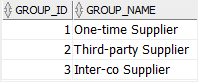
To insert a new third-party supplier, you have to use the group_id 2 as follows:
Code language: SQL (Structured Query Language) ( sql )
INSERT INTO suppliers(supplier_name, group_id) VALUES('Toshiba',1);
It works perfectly fine. However, the following statement also works:
Code language: SQL (Structured Query Language) ( sql )
INSERT INTO suppliers(supplier_name, group_id) VALUES('WD',4);
The supplier_groups table has no row with group id 4 but nothing prevents you from inserting it into the suppliers table, which is an issue.
For example, the following query fails to get all suppliers and their groups:
Code language: SQL (Structured Query Language) ( sql )
SELECT supplier_name, group_name FROM suppliers INNER JOIN supplier_groups USING(group_id);

As you can see, the WD supplier is missing in the result set.
A solution to fix this problem is to use the Oracle foreign key constraint to enforce the relationship between rows from the supplier_groups and suppliers tables.
First, drop the suppliers table:
Code language: SQL (Structured Query Language) ( sql )
DROP TABLE suppliers;
Second, recreate thesuppliers table with a foreign key constraint:
Code language: SQL (Structured Query Language) ( sql )
CREATE TABLE suppliers ( supplier_id NUMBER GENERATED BY DEFAULT AS IDENTITY, supplier_name VARCHAR2(255) NOT NULL, group_id NUMBER NOT NULL, PRIMARY KEY(supplier_id), FOREIGN KEY(group_id) REFERENCES supplier_groups(group_id) );
In this statement, the following clause was newly added:
Code language: SQL (Structured Query Language) ( sql )
FOREIGN KEY(group_id) REFERENCES supplier_groups(group_id)
This clause defines the group_id column in the suppliers table as a foreign key that references to the group_id column of the supplier_groups table.
This way, the constraint is enforced by Oracle. In other words, attempting to insert a row into the suppliers table that does not correspond to any row in the supplier_groups table will fail, as attempting to delete a row from the supplier_groups table where there exist dependent rows in the suppliers table.
The suppliers table is called a child table while the supplier_groups is referred to as a parent table. To extend the parent-child analogy, the primary key value is taken from the parent table (supplier_groups) and is inserted into the child table (suppliers) i.e., the child carries a FOREIGN KEY as the parent's DNA or genetic code.
By the way, the concept of referential integrity is all about maintaining and enforcing this parent-child relationship.
Oracle foreign key constraint in actions
The following statement works because the supplier_groups table has a row with group_id 1:
Code language: SQL (Structured Query Language) ( sql )
INSERT INTO suppliers(supplier_name, group_id) VALUES('Toshiba',1);
However, the following statement will fail:
Code language: SQL (Structured Query Language) ( sql )
INSERT INTO suppliers(supplier_name, group_id) VALUES('WD',4);
Because the supplier_groups has no row with id 4. The following is the error message:
Code language: SQL (Structured Query Language) ( sql )
SQL Error: ORA-02291: integrity constraint (OT.SYS_C0010646) violated - parent key not found
Similarly, attempting to delete a row with group_id 1 in the supplier_groups table will fail:
Code language: SQL (Structured Query Language) ( sql )
DELETE FROM supplier_groups WHERE group_id = 1;
Oracle issued the following error message:
Code language: SQL (Structured Query Language) ( sql )
SQL Error: ORA-02292: integrity constraint (OT.SYS_C0010654) violated - child record found
Because the suppliers table (child table) has a row that references to the row which is being deleted.
Oracle foreign key constraint syntax
Oracle allows you to create, add, drop, disable and enable a foreign key constraint.
Create a foreign key constraint
The following statement illustrates the syntax of creating a foreign key constraint when you create a table:
Code language: SQL (Structured Query Language) ( sql )
CREATE TABLE child_table ( ... CONSTRAINT fk_name FOREIGN KEY(col1, col2,...) REFERENCES parent_table(col1,col2) ON DELETE [ CASCADE | SET NULL ] );
Let's examine the statement in detail.
First, to explicitly assign the foreign key constraint a name, you use the CONSTRAINT clause followed by the name. The CONSTRAINT clause is optional. If you omit it, Oracle will assign a system-generated name to the foreign key constraint.
Second, specify the FOREIGN KEY clause to defines one or more column as a foreign key and parent table with columns to which the foreign key columns reference.
Third, use the ON DELETE clause to specify consequence when the rows in the parent table are deleted.
-
ON DELETE CASCADE: if a row in the parent is deleted, then all the rows in the child table that reference the removed row will be deleted. -
ON DELETE SET NULL: if a row in the parent is deleted, then all the rows in the child table reference the removed row will be set to NULL for the foreign key columns.
Unlike the primary key constraint, a table may have more than one foreign key constraint.
Add a foreign key constraint to a table
If you want to add a foreign key constraint to an existing table, you use the ALTER TABLE statement as follows:
Code language: SQL (Structured Query Language) ( sql )
ALTER TABLE child_table ADD CONSTRAINT fk_name FOREIGN KEY (col1,col2) REFERENCES parent_table(col1,col2);
Drop a foreign key constraint
To drop a foreign key constraint, you use the ALTER TABLE statement below:
Code language: SQL (Structured Query Language) ( sql )
ALTER TABLE child_table DROP CONSTRAINT fk_name;
Disable a foreign key constraint
To temporarily disable a foreign constraint, you use the following ALTER TABLE statement:
Code language: SQL (Structured Query Language) ( sql )
ALTER TABLE child_table DISABLE CONSTRAINT fk_name;
Enable a foreign constraint
Similarly, you use also use the ALTER TABLE statement to enable a disabled foreign key constraint:
Code language: SQL (Structured Query Language) ( sql )
ALTER TABLE child_table ENABLE CONSTRAINT fk_name;
In this tutorial, you have learned how to use the Oracle foreign key constraint to enforce the relationship between tables.
Was this tutorial helpful?
How To Create Foreign Key In Sql Developer
Source: https://www.oracletutorial.com/oracle-basics/oracle-foreign-key/
Posted by: solisviturts.blogspot.com
0 Response to "How To Create Foreign Key In Sql Developer"
Post a Comment